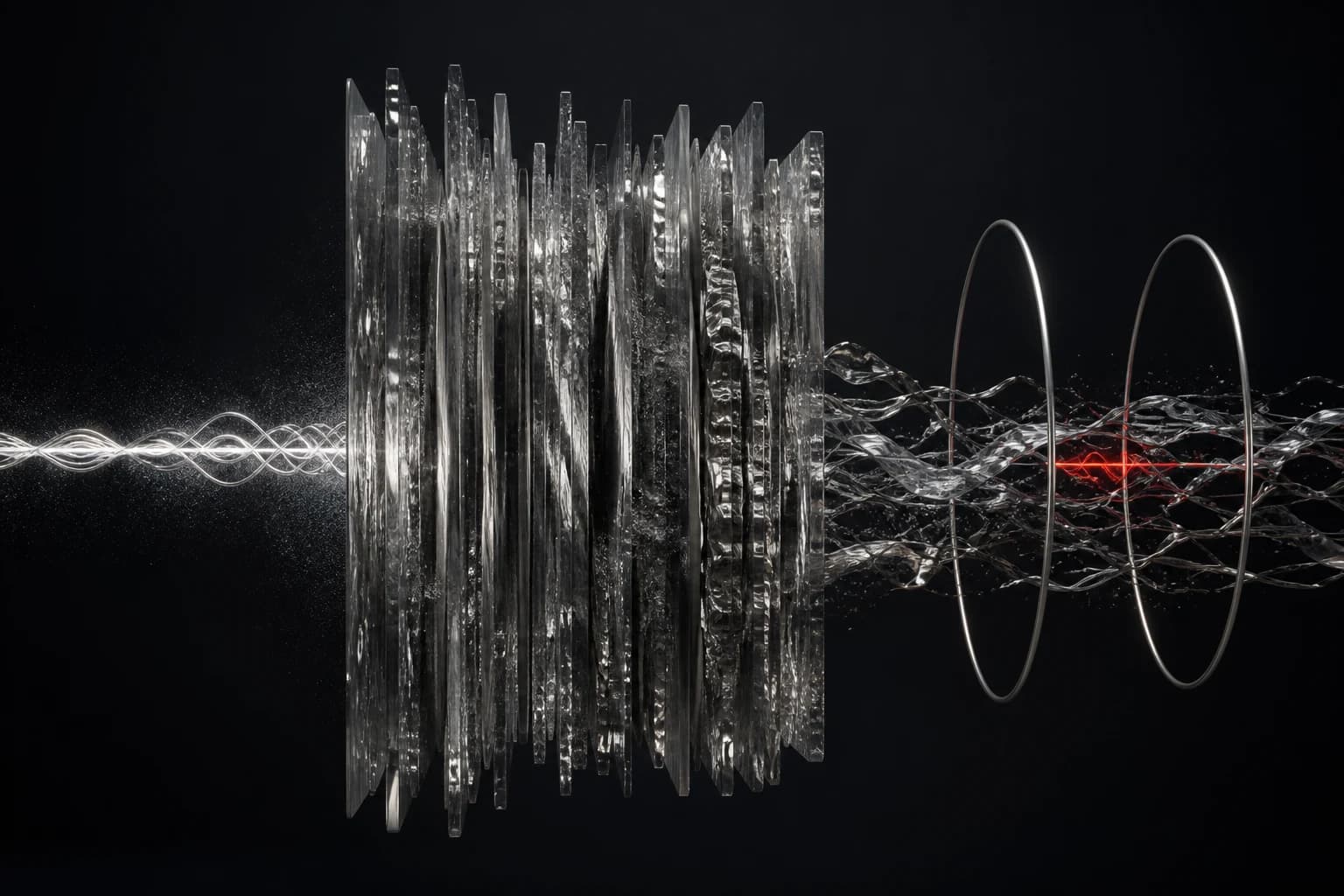
The clean-track result did not travel
An AI music detector can look almost flawless when the song is clean and playing on its own. Television is messier.
A new paper tests two convolutional detectors on BAMM, a 40-hour set of real TV recordings. Music sits behind speech, gets cut short, passes through production effects and reaches the monitor as compressed, low-quality audio.
Both detectors scored 0.992 F1 on clean foreground tracks. On the real broadcasts, the clean-trained model fell to 0.186. A second model trained on simulated broadcast mixtures did better, but only reached 0.472.
That is a large gap between recognising a tidy file and finding the same kind of signal once television has handled it.
Forty hours of actual broadcasts
BAMM is balanced at roughly 20 hours of AI-labelled music and 20 hours of human-made music. Its clips run from five to 60 seconds and were pulled from broadcasts aired between January 2025 and March 2026.
The source archive monitors more than 4,200 channels around the world. Researchers first matched reference tracks to broadcast recordings with audio fingerprints, then kept clips where a separate system found foreground or background music.
The audio is mono, sampled at 8 kHz and encoded at about 40 kbps. That is worse than what viewers normally hear, but the authors say it reflects the proxy streams used for industrial monitoring. In other words, this is close to the material an automated rights system might actually receive.
The paper says the recordings are public on Zenodo and names a GitHub repository for code. Neither link resolved publicly when Model Current checked on 10 August, so the dataset could not yet be inspected independently here.
Training for broadcast helped, just not enough
The two detectors share the same six-layer CNN architecture and look at five-second mel-spectrogram windows. One learned from clean music. The other was trained on a mix of music and speech, with 70% mixed samples and 30% clean ones.
On a synthetic TV benchmark, the clean model scored 0.342 F1 and the broadcast-trained model 0.661. On real TV, those numbers dropped again to 0.186 and 0.472. Their ROC scores also fell, from about 0.997 on clean material to 0.707 and 0.775 on real broadcasts.
Foreground music was easier than background music. The score distributions suggest many AI-labelled clips were missed, especially when the music sat underneath other sound. Human-made clips were more often pushed toward the expected end of the scale.
Simulated noise taught the detector something useful. It did not recreate the full mess of an edited broadcast.
The benchmark has a narrow target
This is not a test of every AI music detector. Both evaluated systems are CNN variants, and the generated-music side centres on Suno v3.5. The authors say model-agnostic detection remains an open problem.
Ground-truth construction also needs care. Human references were limited to releases from 2020 to 2022. Candidate AI tracks were kept only when five different detectors agreed after conservative calibration, rather than because every track came with verified generation provenance.
That unanimous filter is designed to reduce false positives. It can still favour the artefacts those detectors already know how to see. The study is best read as a hard test for a specific detection family, not a census of synthetic music on television.
The work was supported in part by the UPF-BMAT AI and Music chair and BMAT Music Innovators. BMAT operates in music monitoring, which makes the real-world setting useful and the industrial context worth keeping visible.
What is confirmed, found and still open
Confirmed: the five-author paper was submitted on 7 August 2026 and accepted at ISMIR 2026. It reports a 40-hour real-broadcast dataset and tests clean-trained and broadcast-trained CNN detectors across clean, synthetic and real conditions.
The research finding: performance fell sharply as the audio became more realistic. Broadcast-style training reduced the damage but did not make detection reliable, particularly when music was in the background.
The authors’ claim: BAMM is a public benchmark that exposes a gap missed by clean and synthetic datasets. Public access to the named data and code could not be confirmed at publication time.
Still open: performance on other generators, newer detectors, higher-quality feeds and broadcasts outside this archive. It is also unclear how a rights or transparency system should act when a score is uncertain.
For now, a detector result should not be treated like a label printed on the music. Where the audio came from, how it was mixed and what the detector was trained to hear all matter.
Sources
- López-Ayala et al. - Assessing AI-generated music detection in real-world broadcast monitoringPrimary paper record submitted 7 August 2026 and accepted at ISMIR 2026. Source for authorship, dataset scope and the main result.
- López-Ayala et al. - Full BAMM paperFull primary manuscript. Source for dataset construction, model architecture, funding, exact performance figures and limitations discussed here.
- López-Ayala et al. - AI-Generated Music Detection in Broadcast MonitoringEarlier primary ICASSP 2026 paper from the same research line. Source for the synthetic AI-OpenBMAT benchmark used as the intermediate evaluation setting.