The missing layer is often not the model
A modern lab can contain equipment from several decades and several vendors. One instrument has an API. Another uses an older desktop program. A third has only a screen a person normally clicks through. Making them work together can take months of custom engineering before an AI system even enters the picture.
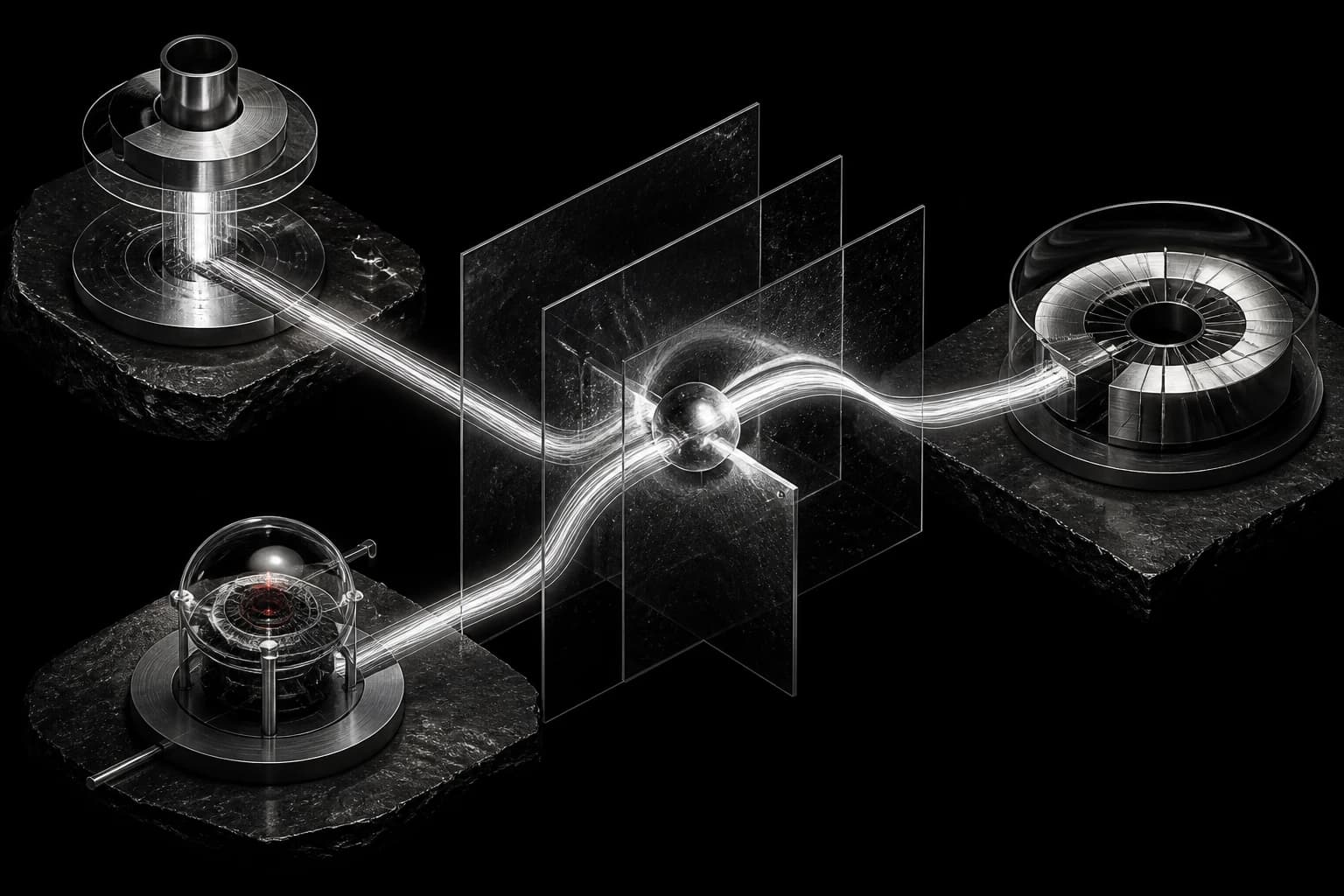
Anthropic’s Model Hardware Standard, or MHS, is an attempt to make that part less bespoke. The company has opened it as a limited research preview for scientific labs and advanced manufacturers. The proposal is simple in spirit: give each programmable device a standard driver, describe its capabilities and limits in a shared format, then let an agent work through that common interface.
This is not a product that turns a lab over to a chatbot. It is a technical standard in preview. Its importance is that an agent can only be meaningfully evaluated around real equipment once the equipment is reachable in a consistent, inspectable way.
What the standard proposes
MHS uses a driver to translate between an operating system and a particular device. Anthropic describes a small set of primitives such as read, for checking a temperature or status, and write, for setting a value. The driver can also expose a machine-readable description of what the device measures, what can change and which limits should be enforced.
That last part matters. A language model does not learn the weight of a robot arm, the safe range of a laser or the conditions under which a liquid handler should stop just by reading generic code. MHS is designed to make that local knowledge available in a standard reference file, with natural-language tags supplied by the operator or captured during setup.
Anthropic says the interface can be used through MCP, a command line or code files, and that it is model-agnostic. The public MHS site says access is by application during the research preview while partners test the standard, build safety evaluations and develop operational practices ahead of an intended open-source release.
The early examples are promising, and bounded
The announcement includes demonstrations from research and industrial partners. In one Genentech proof of concept, Anthropic says Claude coordinated a liquid handler, a robotic arm and a plate reader while researchers optimised transfer settings for water and a viscous protein sample. The company also describes cases at the University of Washington and Carnegie Mellon involving monitoring, qPCR and dose-response experiments.
The most striking reported result comes from QuEra, where Anthropic says an agent used MHS to improve a laser-recovery script. In the company’s later 700-trial test of the resulting deterministic script, it reportedly recovered the lock 695 times. That is a partner example reported by Anthropic, not an independent general benchmark of agent-run hardware.
The examples do not hide every limitation. In the Genentech work, the model retried a bubble-related liquid-handling failure in a way that made the problem worse until people gave it the relevant physical explanation. That is a useful detail. An agent may know how to sequence tools long before it understands the material world well enough to improvise safely.
A common interface does not create common responsibility
A standard can make it much easier to connect equipment. It does not decide who may run a procedure, which action needs a second person, how an emergency stop is tested or what evidence is required before a result is trusted. Those are design and governance decisions, especially in biomedical, manufacturing and quantum settings.
The value of MHS may be clearest in narrow, repeatable tasks that already have clear limits and good logs. A model can help observe, plan and recover within those boundaries. The less defined the task and the higher the cost of a mistake, the more the system needs explicit checks and a person who can intervene.
This is why the preview status matters. Anthropic and its partners are still working on safety evaluations and best practices. The standard offers a route to test physical agents in a more disciplined way. It does not settle the harder question of when an agent should be allowed to act alone.
What is confirmed, what Anthropic says, and what is open
Confirmed: Anthropic announced the MHS research preview on 27 August 2026. The public MHS site says the project began with HHMI Janelia Research Campus, is currently limited to an application-based preview and is intended to become open source later.
Anthropic’s claims: MHS can reduce equipment-integration work from weeks or months to hours or minutes in some cases; it is model-agnostic; and the partner demonstrations show useful automation, fault handling and faster iteration.
Open questions: how drivers and safety limits will be reviewed, how the standard behaves with legacy or poorly documented equipment, what independent reliability data will show, which audit records are required and where human approval must remain mandatory.
Sources
- Anthropic — Previewing the Model Hardware StandardPrimary Anthropic announcement, published 27 August 2026. Source for MHS design, preview scope, technical interface, partner demonstrations, reported results and stated limitations.
- Model Hardware Standard — research previewPrimary project site. Source for the origin with HHMI Janelia, application-based preview, intended open-source path and stated work on evaluations and operating practices.