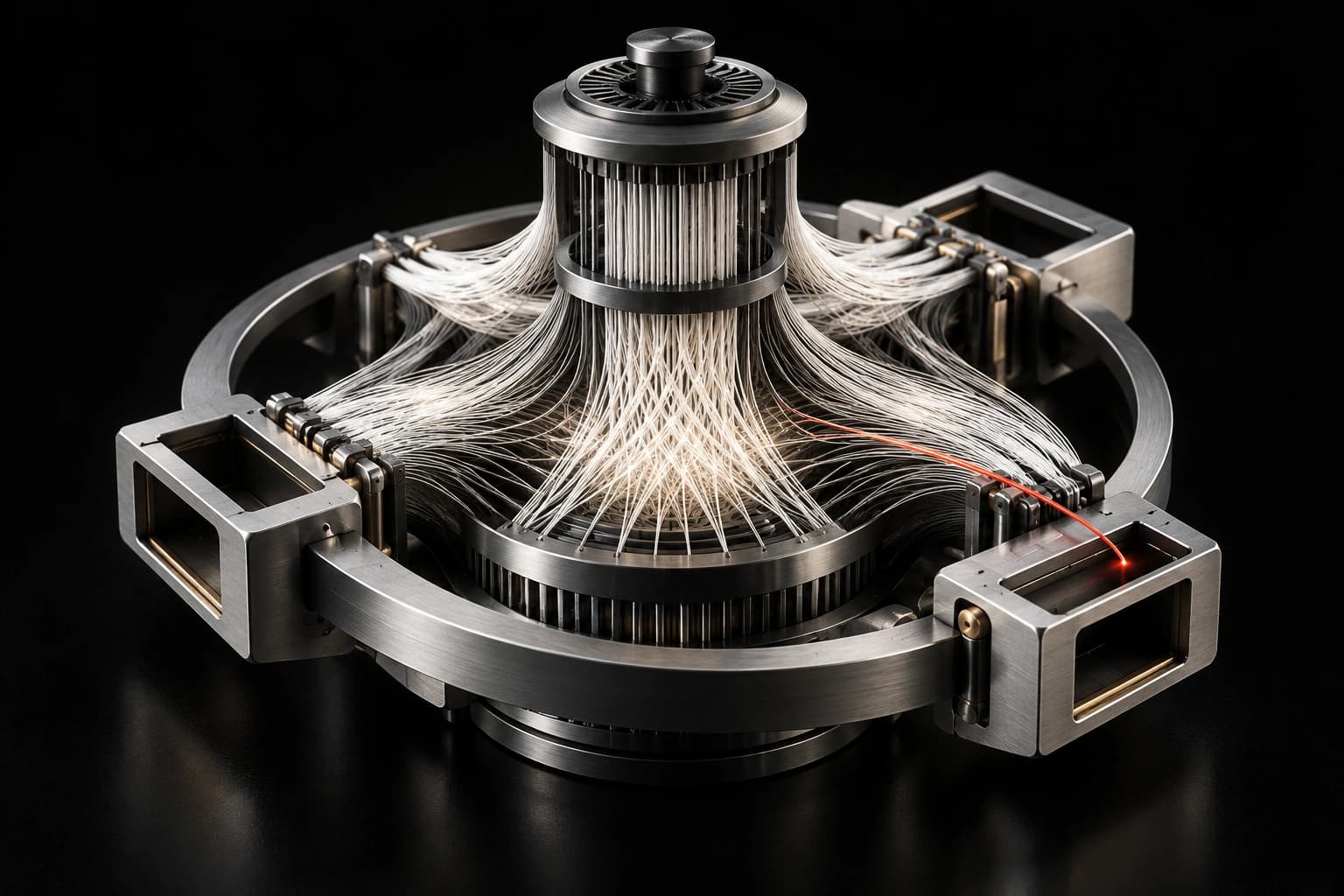
An engine made available for inspection
DeepSeek has published DeepInfer, the inference framework it says powers its large-scale production services. The public repository’s initial commit is dated October 20. Its README describes this release as an offline inference engine, not the whole service that handles live customers.
Inference means running an already trained model to produce an answer. Releasing the engine lets developers inspect how that computation is organized. It does not, by itself, provide the surrounding machinery needed to run a dependable public endpoint.
What the release contains
The repository lists DeepSeek-V4.1-Flash support and two hardware families: NVIDIA SM100 GPUs and Huawei Ascend 950 accelerators. It includes optimized computation, scheduling and constrained output formats. These are the project’s documented capabilities; this desk has not compiled or benchmarked the code.
DeepInfer is licensed under Apache 2.0. That software license is a different question from the terms for model weights, the cost of suitable hardware or a promise of operational support. An open engine should not be read as free hosted capacity.
The surrounding service is still a separate job
The README names three missing pieces for a complete service: a KV-cache system, separation of vision encoding, prompt processing and answer generation, and load balancing across replicas. Some engine functions for that separation already exist, it says.
A KV cache retains intermediate computations so a model need not redo the same work. Load balancing decides where incoming work goes. Separating stages allows different machines to handle different parts of a request. Together, these choices affect the experience of many people using a system at once.
DeepSeek’s accompanying deployment Q&A describes its own approach to cache storage, request routing, scaling and recovery. Those descriptions are useful architectural context, but they should not be mistaken for a claim that every described component ships in this repository.
What to test before drawing a cost conclusion
The published benchmark setup uses four SM100 GPUs for prompt processing and 64 for generation. Results from that configuration cannot establish the cost or response time of a different deployment.
A practical evaluation would hold the model and workload fixed, then measure waiting time, output speed, failures and the resources needed for the complete service. It should include long requests and traffic spikes, not just a favorable steady stream.
The immediate development is access to code and engineering detail. Whether it lowers a particular operator’s costs remains a workload-specific question, not a result established by the release.
Sources
- DeepSeek: DeepInfer repository and READMEPrimary release scope, hardware, offline engine, missing service components and benchmark setup checked directly. Production-use and capability statements attributed; no independent run.
- DeepInfer commit historyGitHub API independently confirms initial commit d585e6542c0571176272d703f03c4807ae901284 at October 20 04:09:42 UTC; current snapshot also captured.
- DeepInfer deployment Q&APrimary description of DeepSeek’s service architecture, cache, routing, scaling and fault tolerance. Descriptions not treated as all included in the release.
- DeepInfer Apache 2.0 licenseSoftware licensing verified in repository license; does not establish separate model terms, free compute or a support guarantee.