A glucose trace contains more than one kind of change
A continuous glucose monitor takes readings every few minutes from a small sensor under the skin. Over a day, the trace can show a fairly slow baseline as well as much faster changes after a meal, activity, sleep or a sensor interruption. Looking at all of it as one flat sequence can hide that difference.
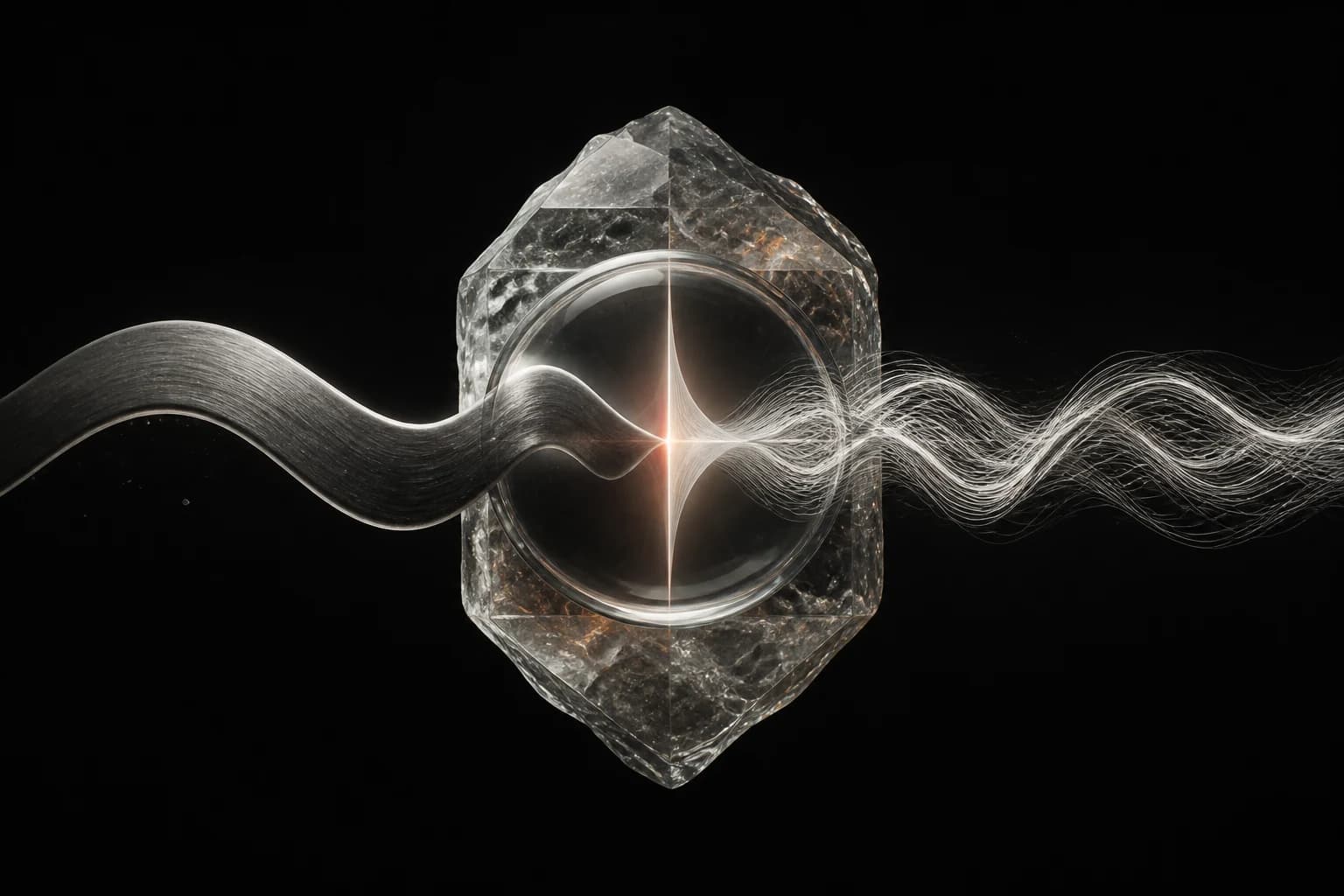
Google Research’s GlucoFM is built around that simple idea. It uses one stream for slower glucose trends and a second for short-lived deviations, then joins the two. The researchers say this helps the model learn reusable representations from glucose records even when there are few costly clinical labels available.
This is research, not a new consumer feature. The paper describes GlucoFM as a prototype for retrospective physiological representation learning. It does not offer a diagnosis, tell a person what to eat or replace medical advice.
What Google tested
The team pre-trained the model on 109,066 hours of unlabeled CGM recordings from 477 participant records. It then tested frozen model representations across four separate cohorts and seven prediction tasks, including diabetes-risk assessment, insulin resistance, beta-cell dysfunction, hypoglycaemia and obesity classification.
The comparisons were designed to keep people separate between training and testing. That matters in health research: a model can look better than it is if it has already seen patterns from the same people during training. The paper says it also retrained several CGM-specific baselines on the same pre-training corpus for a more controlled comparison.
Across 14 cohort-task evaluations, the authors report average precision-recall performance of 58.8, compared with 54.7 for the strongest CGM-specific baseline retrained on the same data. That is a 4.1-point absolute gain. It is a result within this study, not proof of accuracy for every patient, device or clinical setting.
The encouraging part is transfer, not a health score
Health datasets are often small, expensive and hard to share. A model that can learn a useful pattern from unlabeled sensor traces, then adapt with only a little labelled data, could be useful to researchers working on narrow questions.
GlucoFM also performed well in the authors’ cross-dataset tests. They report that it led in 11 of 12 tested transfers against the strongest competing model, and that it retained an advantage in few-shot settings. The study’s meal-response experiment involved 874 paired meal events from 34 participants, which is informative but still small.
Those tests suggest a possible research benefit: the same underlying model may carry some useful context from one cohort to another. They do not establish that it works equally well across ages, ethnicities, health conditions, sensor habits or healthcare systems that the study did not cover.
Why the limits need to stay in the headline
The paper is on arXiv, which means it is a public preprint rather than a peer-reviewed clinical study. Its authors are clear that the pre-training population is still modest and that they plan to train on larger, more diverse populations and explore longer time windows.
A strong retrospective prediction result is not the same as a safe clinical tool. Before a system could influence diagnosis, treatment or triage, it would need prospective testing, careful assessment of error patterns, clinical workflow design and the relevant regulatory review. None of those steps is supplied by this announcement.
There is still value in the smaller claim. Wearable sensors produce far more data than researchers can label by hand. Better ways to learn from that data could make future studies more practical. The present result is a model and a set of benchmarks, not a result someone should act on medically.
What is confirmed, what Google says, and what is open
Confirmed: Google Research published its GlucoFM overview on 26 August 2026, and the accompanying preprint describes the dual-stream model, its 477-record pre-training set, the tested cohorts and the reported retrospective results. The paper calls the system a research prototype.
Google’s claims: separating slower state patterns from short-term events produces more useful glucose representations than the baselines it evaluated, including when labels are limited or a model moves to a new cohort.
Open questions: independent replication, results in larger and more diverse populations, performance under real clinical conditions, how results vary by sensor and diagnosis, and whether any future use would improve outcomes rather than only a retrospective benchmark.
Sources
- Google Research — GlucoFM: Foundation model for continuous glucose monitoringPrimary Google Research announcement, published 26 August 2026. Source for the model description, study design, reported evaluations, data scale and stated next steps.
- GlucoFM: A Dual-Stream Foundation Model for Continuous Glucose MonitoringPrimary research preprint. Source for the prototype status, cohort counts, subject-separated evaluation design, comparison setup, reported results and limitations.