Why put spacetime on a grid?
The Standard Model describes elementary particles and three of the forces that act on them. Its predictions can be remarkably precise. But one way to make those predictions, starting with particles that do not interact and adding the effects of their interactions in small steps, is not useful for every problem.
A lattice is a grid of points used in place of continuous spacetime. It gives physicists a way to put interactions into the calculation from the start. A straightforward grid introduces a problem for the weak force, which treats left- and right-handed versions of some particles differently: the grid can bring in extra partners the theory should not contain.
Who did what
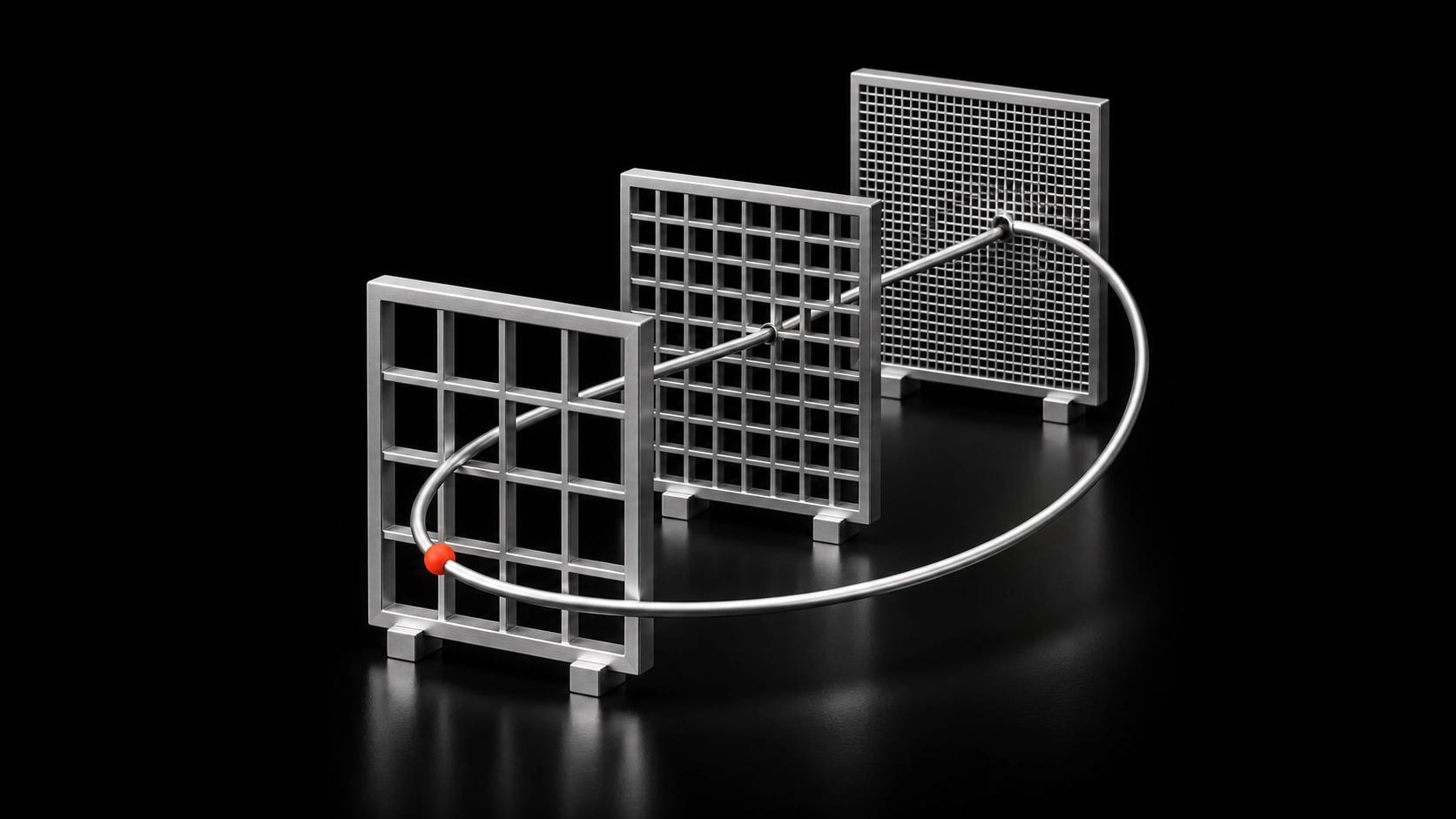
Nathaniel Craig, a UC Santa Barbara physicist and visiting scientist at OpenAI, outlined his approach on OpenAI’s science blog on 15 November. The underlying preprint was posted on 6 October. Craig says he proposed comparing the same force fields on finer and finer grids to work out how to define the fermions, the class of particles that includes quarks and electrons, consistently on the original grid.
In Craig’s account, Astra found a way to transfer the fields between grids and led the detailed proof. The preprint credits rounds of work with the model and outside experts. It describes a construction under a bound on how strong the fields may be at the scale of the grid. The new essay is an account of the work, not a new proof or peer review.
What remains to be shown
The preprint proposes a candidate definition at fixed grid spacing. That is different from proving that the full interacting theory is well defined in continuous spacetime, where the gap between grid points would shrink to zero. Craig also identifies a mathematical condition needed to connect the grid calculations to a quantum theory with conserved probabilities as a question for further work.
The paper gives specialists something concrete to check: a mathematical construction with stated assumptions. Neither the AI’s role in deriving it nor the fact that experts discussed the proof settles whether the construction has all the properties physicists need.
Sources
- Nathaniel Craig: A step toward defining the Standard Model on a latticeFirst-person account dated November 15: roles, grid method, constraints and outstanding questions.
- Nathaniel Craig: A gauge-invariant measure for lattice chiral fermionsOctober preprint; mathematical statement, acknowledgments and discussion of limitations.
- Kavli Institute for Theoretical Physics: Nathaniel CraigUniversity profile confirms Craig’s UC Santa Barbara particle theory role.