The error that stays after the camera moves
A robot can carry an old mistake into a new task. If its stored description names the wrong object, a later question may retrieve that error rather than re-examine the image. MIT highlighted one attempt to address this problem on November 5: a system called UQ-DAAAM.
This is an explainer tied to that account, not a claim that the underlying paper is new today. Harry Zhang, Nicolas Gorlo and Luca Carlone first posted their manuscript on arXiv on June 6.
Spend the second look where it is needed
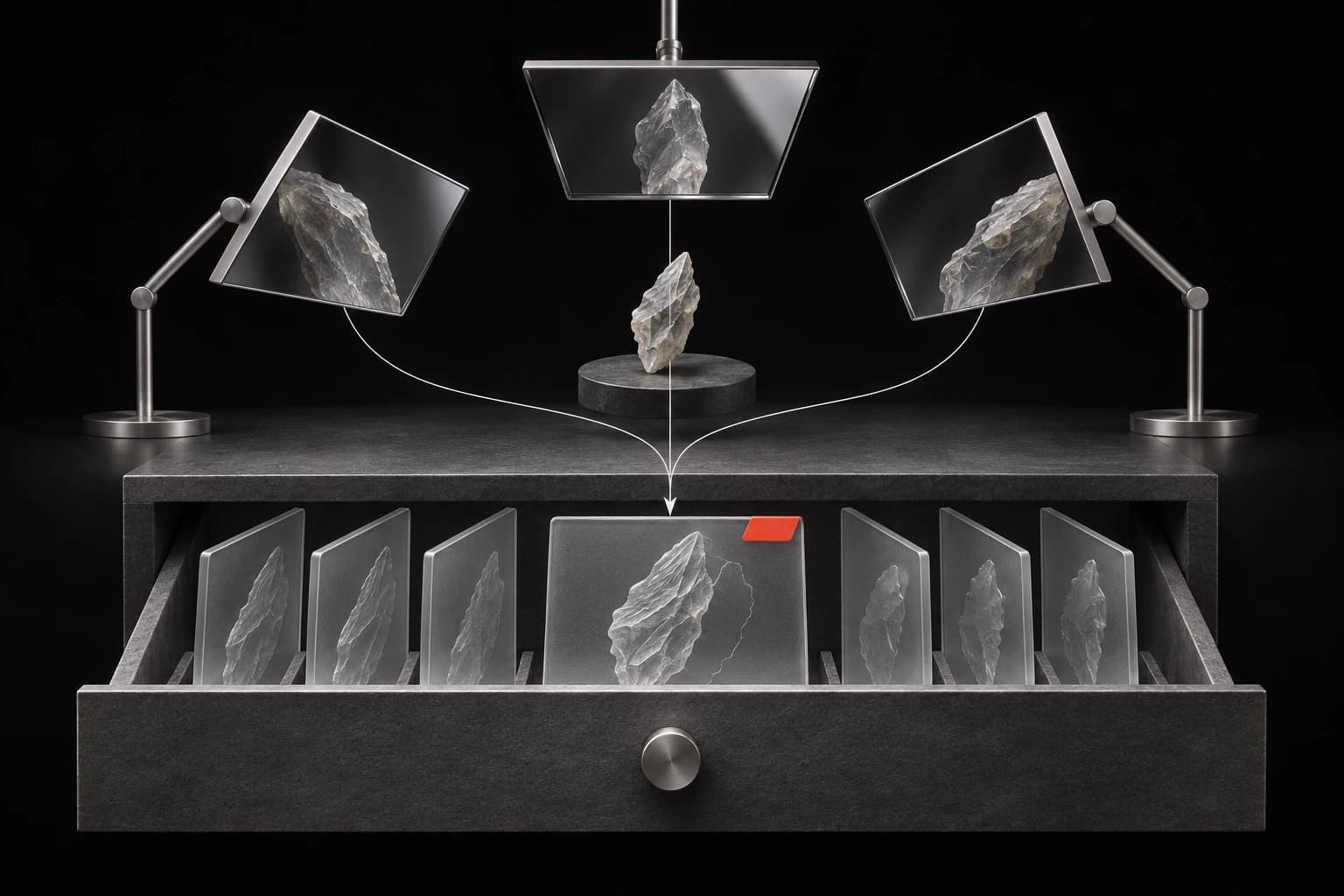
The method compares descriptions of the same object from different viewpoints. It uses their disagreement, together with signals about individual captions, to flag uncertain memory entries. It then selects additional views and combines the descriptions under a limited query budget.
Think of this as deciding which entries deserve review, rather than adding a confidence label to every answer. A memory system needs a way to revise stored information, not just repeat it more fluently.
Two measurements that should not be confused
In the paper’s fixed-budget experiment, 92.3% of initially uncertain objects moved below the chosen uncertainty threshold after refinement. That does not mean 92.3% of all objects were correctly identified. The denominator is the uncertain subset, and the outcome is crossing a threshold.
The authors separately report descriptive-question accuracy of 0.761 for their method, compared with 0.711 for the original DAAAM baseline on OC-NaVQA. Those are benchmark results from the authors, not independent replication or evidence that a robot can safely perform arbitrary physical tasks.
Agreement can still be wrong
The paper explicitly warns that several views can support the same mistaken description. Additional queries also cost time, and retaining more captions and refinement history uses memory.
For anyone evaluating a robot-memory demonstration, the useful questions are therefore separate: did uncertainty fall, did answers improve, and did the system behave safely in the intended task? One score cannot answer all three. The contribution here is a more inspectable route to revising memory—not a guarantee that confidence has become truth.
Sources
- MIT News: Clearing up a robot’s fuzzy memoryNovember 5 institutional account and current-events peg. Explains persistent caption errors and targeted refinement; not an independent reproduction of the authors’ study.
- arXiv: Remember with Confidence — submission recordPrimary manuscript metadata confirming authors and first submission on June 6, 2026. No claim that the preprint was first published in November.
- Remember with Confidence — full manuscriptPrimary methods, Table1, Figure2 and SectionN limitations. 92.3% is uncertainty-threshold crossing in the initially uncertain subset; question accuracy is measured separately. Authors’ results, not independently reproduced.