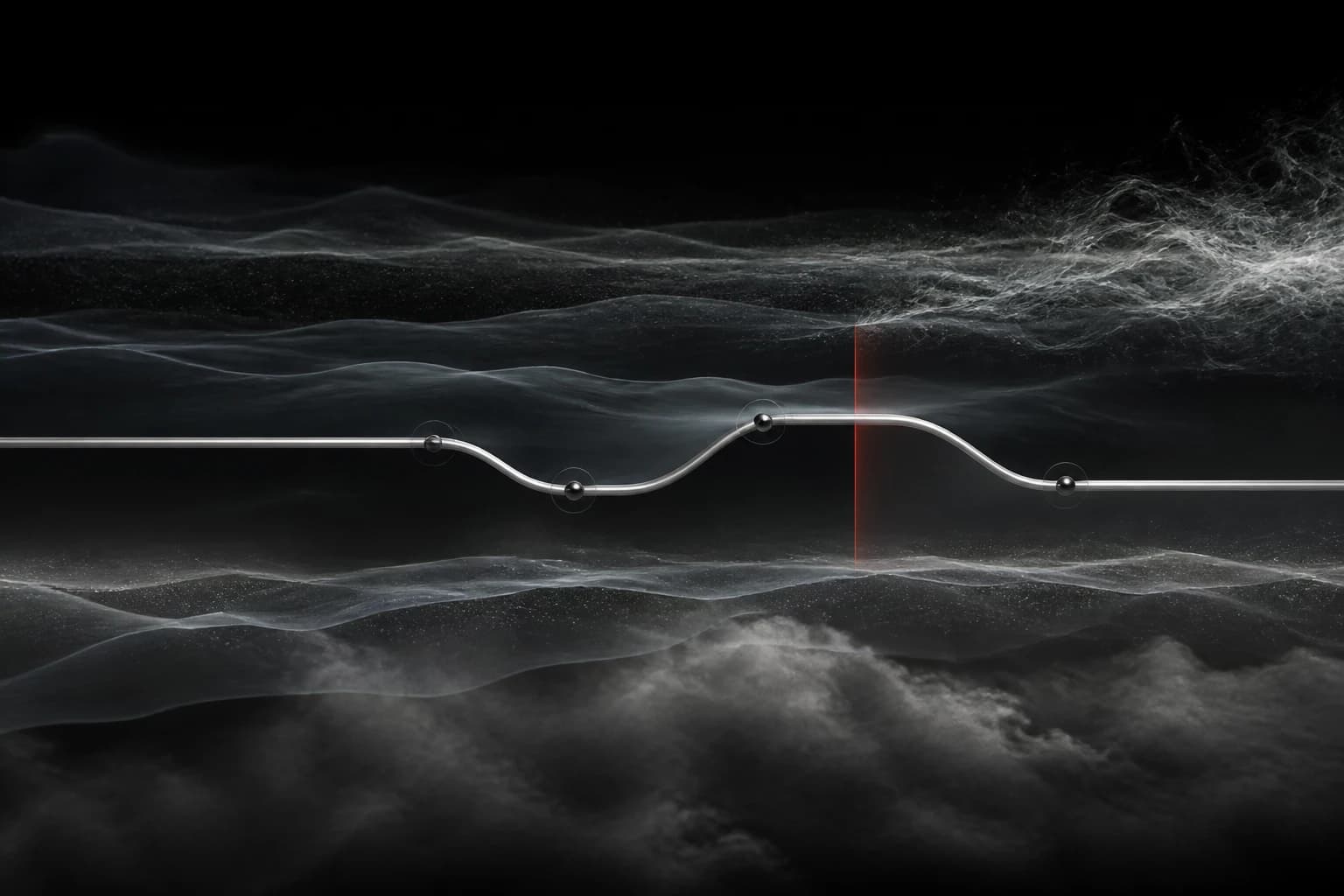
A flight plan is becoming a climate-control surface
Google and Cathay Pacific have begun testing a simple idea with a difficult scientific target: change an aircraft's altitude a little, at the right time, and it may avoid the cold, humid air that produces persistent contrails. Those white trails can spread into thin cloud and trap heat. The new trial extends work Google has already tested in North America and the North Atlantic into Asia-Pacific long-haul operations.
The announcement is about an operational trial, not a new aircraft or a new fuel. Google says dispatchers and pilots receive forecasts before departure, then pilots can see updated information in Cathay Pacific's flight-deck workflow. The proposed interventions are small altitude shifts within normal safety procedures.
That makes the story more useful than another promise about a future climate technology. The question is whether forecasts, airline procedures and pilots can work together often enough to reduce warming without creating bigger costs or risks elsewhere in the flight plan.
What the early result does and does not measure
Google says the first phase targeted more than 100 Cathay Pacific flights and that more than 80 followed contrail-avoidance routes. Using its satellite imagery analysis, it estimates that those flights reduced the warming impact of contrails by roughly 40%. The Hong Kong to Singapore corridor was one of the routes tested.
The wording around that number matters. It is Google's estimate of contrail warming impact for the flights in the trial. It is not a direct measurement of a global temperature change, a finding about all aviation emissions or a proof that every altitude adjustment will have the same effect on another route or season.
Google also says one route accounted for more than half of the trial's estimated emissions reductions. That is a reminder that the benefit may be concentrated in particular airspace and weather conditions. A result from a small group of well-targeted flights is useful evidence for a next phase. It is not yet a general operating rule.
Contrails matter, but their size is still uncertain
Persistent contrails are not the same as the short white line visible behind every aircraft. They form when an aircraft passes through conditions that allow ice crystals to persist and spread. The climate effect is short-lived compared with carbon dioxide, but it can be significant in the near term because the resulting cloud can reduce heat escaping to space.
The Intergovernmental Panel on Climate Change assessed contrails and aviation-induced cirrus as the largest individual positive effective radiative forcing from aviation in 2018. The assessment also assigns low confidence to the size of that forcing, partly because important cloud processes are still difficult to represent. The potential is real. So is the uncertainty.
That is why route planning is not a free climate credit. A detour or altitude change may alter fuel use and carbon dioxide emissions. Forecasts may be wrong at the exact place and time a decision is made. Any airline programme needs to compare those trade-offs, not simply count avoided trails.
The next test is operational, not only technical
Google says its system brings together AI predictions, satellite imagery and weather intelligence, while Cathay Pacific links the resulting information to pilots through in-flight Wi-Fi and its Electronic Flight Folder. The second phase is intended to test more flights across Asia and transpacific routes, with Contrails.org contributing to the research effort.
Operational feasibility is the central issue. A useful forecast must arrive early enough for dispatch planning, survive changes in weather and air-traffic constraints, fit a pilot's workload, and be evaluated against fuel and safety considerations. The IPCC has noted that meteorological models have not always predicted persistent contrails accurately enough in time and space for broad mitigation to be straightforward.
The trial should therefore be judged less by the appeal of a 40% headline than by the evidence it produces on those conditions. Route-by-route results, methods for estimating impact and a transparent account of trade-offs would be more valuable than a claim that AI has solved aviation's climate problem.
What is confirmed, what Google says, and what is open
Confirmed: Google published the Cathay Pacific trial announcement on 7 September 2026. It says more than 100 flights were targeted, more than 80 followed contrail-avoidance routes, and a larger phase is now planned. The IPCC has assessed contrails and aviation-induced cirrus as an important but uncertain part of aviation's climate effect.
Google's claims: the early flights achieved a roughly 40% estimated reduction in contrail warming impact; its forecast and satellite approach is operationally practical; and contrail mitigation can be a scalable, cost-effective climate measure. Those findings and interpretations come from Google and its trial analysis.
Open questions: how the estimate was validated, how often the forecasts will be accurate outside the trial, what fuel and carbon dioxide trade-offs result, whether the approach works on a broader range of routes and aircraft, and what independently reviewed evidence will show as the partnership expands.
Sources
- Google — Our new contrail avoidance trial in Asia-PacificPrimary Google announcement, 7 September 2026. Source for the Cathay Pacific partnership, trial scale, satellite-derived 40% estimate, stated operating workflow and second phase.
- IPCC AR6 WGI, Chapter 6: Short-lived Climate ForcersAuthoritative assessment source for the role of persistent contrails and aviation-induced cirrus, their estimated aviation forcing contribution and the stated uncertainty.